
Gout (podagra)
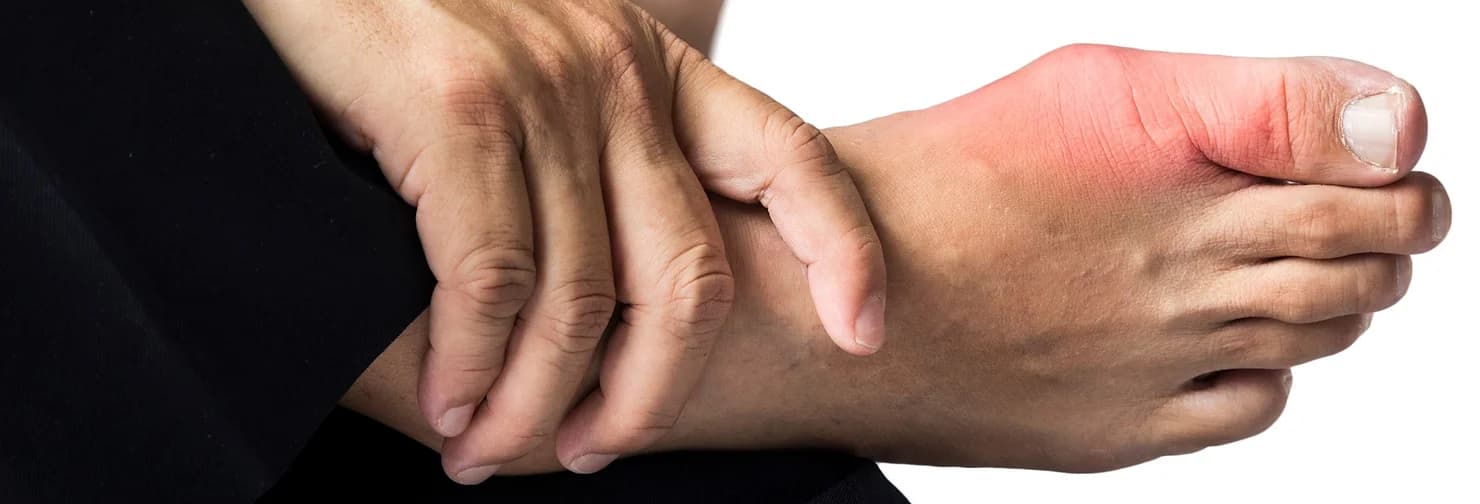
Gout causes sudden, severe pain and swelling in a joint, most often the big toe. Attacks can be treated quickly, and long-term medicine can stop them coming back.
Gout is a type of arthritis that causes sudden attacks of severe pain, swelling and redness in a joint. It most often affects the big toe.¹ Because gout so often targets the foot, the ancient Greeks called it podagra, meaning "foot-grabber".⁶
What is gout?
Gout is caused by too much urate (uric acid) in the body.¹ When there's too much, it can form crystals in and around a joint, and these set off inflammation.¹
High urate levels are the main risk factor for gout. They can be caused by the body making too much urate, or the kidneys and gut not getting rid of enough.⁴
How does gout progress?
- Build-up with no symptoms. Urate builds up slowly, over months or years, usually without symptoms.¹
- Attacks (flares). Crystals trigger sudden attacks of pain and swelling. An attack usually lasts 1–2 weeks and settles on its own, even without treatment.¹,²,⁴
- Time between attacks. You may feel fine between flares, but the crystals are still there, and without treatment attacks can keep coming back.¹
- Long-term (chronic) gout. Over time, repeated attacks can permanently damage the joints.¹ Hard lumps of urate crystals called tophi can form under the skin on the toes, fingers, elbows, ears or Achilles tendon.¹,² High urate can also cause kidney stones.¹
What causes it?
You're more likely to get gout if you:¹,²
- are male, or older than 65
- have close family members who have had gout
- drink a lot of alcohol, especially beer
- eat a lot of red meat or shellfish, or have sugary drinks
- are overweight, or have kidney disease, high blood pressure, type 2 diabetes or high cholesterol
- take some medicines, such as diuretics (fluid tablets), aspirin or some blood pressure medicines.
If you take one of these medicines, don't stop it. Talk to your doctor first.
A flare can be triggered by an illness with a high fever, drinking too much alcohol, a large meal, not drinking enough water, an injury to the joint, or some medicines.²
Signs and symptoms
A gout attack usually causes:¹,²
- sudden, severe pain in a joint
- swelling and warmth over the joint
- red skin over the joint, although redness can be harder to see on brown or black skin.
The big toe joint is most often affected, but gout can also affect other joints in the foot, the ankle, knee, wrist, hand or elbow.²
An infected joint can look like gout, so it's important to get a diagnosis.²
How is it diagnosed?
The most reliable test is to take a small sample of fluid from the painful joint and check it under a microscope for urate crystals.¹ A blood test for urate and an ultrasound can also help.¹
What can help?
During an attack. Your doctor may prescribe anti-inflammatory medicines (NSAIDs), colchicine or a corticosteroid. All three work well for flares.¹,³ At home, rest and raise the foot, keep weight and pressure off the joint, and hold a cold pack wrapped in a cloth on the joint for 10–15 minutes at a time.¹,²
Preventing future attacks. If you have frequent flares, tophi or joint damage from gout, your doctor will usually recommend a medicine that lowers your urate.³ Allopurinol is the usual first choice. It's started at a low dose and slowly increased, with regular blood tests, until your urate is below a target level.³,⁴ The aim is to keep urate low enough for the crystals to dissolve.⁴ Take it every day, even when you feel well.²
Starting urate-lowering treatment can trigger flares in the first months, so your doctor will usually also prescribe a low-dose anti-inflammatory medicine for the first 3–6 months.³,⁴
Lifestyle changes. Cutting back on alcohol and sugary drinks, losing weight gradually if you need to, drinking plenty of water and stopping smoking can all help.¹
What a podiatrist can do. At Foot Ankle Lower Limb we can help with footwear and padding to protect and offload a stiff, sore joint. Comfortable, well-cushioned athletic shoes can make walking more comfortable for people with gout.⁵
When to see a podiatrist or doctor
See your GP if a joint suddenly becomes painful, swollen, stiff or inflamed, especially if pain relief doesn't help.¹ Get medical help urgently if you also have a high temperature or feel hot, cold or shivery, because this could mean an infection inside the joint.²
If gout has left your feet sore or stiff, book an appointment with our podiatrists.
References
- Healthdirect Australia (2026). Gout. https://www.healthdirect.gov.au/gout
- NHS (2023). Gout. https://www.nhs.uk/conditions/gout/
- FitzGerald JD, Dalbeth N, Mikuls T, et al. (2020). 2020 American College of Rheumatology guideline for the management of gout. Arthritis Care & Research, 72(6), 744–760. https://doi.org/10.1002/acr.24180
- Dalbeth N, Choi HK, Joosten LAB, et al. (2019). Gout. Nature Reviews Disease Primers, 5(1), 69. https://doi.org/10.1038/s41572-019-0115-y
- Frecklington M, Dalbeth N, McNair P, et al. (2019). Effects of a footwear intervention on foot pain and disability in people with gout: a randomised controlled trial. Arthritis Research & Therapy, 21(1), 104. https://doi.org/10.1186/s13075-019-1886-y
- Roddy E. (2011). Why does gout target the foot? The pathogenesis of podagra. Journal of Foot and Ankle Research, 4(Suppl 1), A6. https://doi.org/10.1186/1757-1146-4-S1-A6
Reviewed by Andrew Schox, Podiatrist, BSc(Hons) PGradDipPod MPod. Last reviewed October 2026.
Need Professional Podiatry Care?
Our experienced team is here to help with all your foot and ankle concerns. Book an appointment today for expert diagnosis and treatment.
Book an AppointmentRelated Articles

Cortisone injections: relief for foot and ankle pain
A cortisone injection can calm a painful joint, bursa or nerve within days, and the relief often lasts weeks to months. It works best as one part of a wider treatment plan.
Why are my toenails unsightly?
Thick, discoloured or misshapen toenails are common. Fungal infection, injury, ageing, skin conditions and ingrown nails are the usual causes, and most can be treated or managed.
Why do I get calf muscle cramps?
Calf cramps are common and usually harmless, often linked to tired muscles, exercise or age. Cramping pain that comes on with walking and eases with rest is different and needs checking.