
Bunions
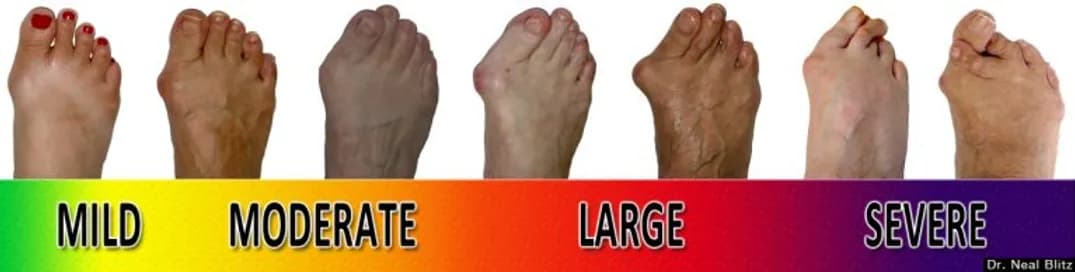
A bunion is a bony bump at the big toe joint that often runs in families. Wider shoes, padding and orthoses can ease the pain, and surgery is an option if they don't help.
A bunion is a bony bump on the side of the foot at the base of the big toe. Bunions are common and tend to run in families. You can't reverse a bunion on your own, but there is a lot you can do to make it more comfortable.
What is a bunion?
The medical name for a bunion is hallux valgus. The big toe (hallux) leans across towards the second toe, which pushes the joint at its base out to the side and forms the bump.⁴ In advanced bunions, the big toe can sit over or under the second toe.
Bunions are very common. About 1 in 4 adults has one, rising to about 1 in 3 people over 65, and women get them more than twice as often as men.¹
What causes it?
The exact cause isn't fully understood, but the foot you inherit plays a big part. Bunions run strongly in families.²,⁴
The shape of the bones matters too. People with bunions are more likely to have a wider angle between the first and second long bones of the foot (metatarsals), a longer first metatarsal and a rounder metatarsal head.³ Bunions can also develop with rheumatoid arthritis or osteoarthritis, or after a foot injury.⁴
What about shoes and flat feet? Narrow, tight shoes and high heels may raise your chance of getting a bunion,⁴,⁵ and a bunion usually hurts more in shoes.⁵ However, the research linking footwear, flat feet or "rolling in" (pronation) to bunions is not conclusive.³ A bunion is unlikely to be simply the result of the shoes you chose.
Signs and symptoms
Not every bunion hurts. Symptoms can include:
- a hard bump on the side of the foot at the base of the big toe
- the big toe pointing towards the other toes
- pain and stiffness in the joint, especially when wearing shoes or walking
- redness, swelling or inflammation over the joint
- hard, thick skin (callus) over the bump
- trouble finding shoes that fit comfortably⁴,⁵
Bunions often get worse over time.⁴ Unmanaged bunions can increase your chance of a fall.⁴,⁸
What can help?
Self-care. Wear wide shoes that let your toes spread out, with a low heel and a soft sole. Avoid high heels and tight, pointed shoes.⁴,⁵ Soft bunion pads can stop shoes rubbing, and an ice pack wrapped in a cloth for up to 5 minutes at a time may ease a sore joint.⁵ Ask your pharmacist or GP before using pain relief medicine.
What a podiatrist can do. At Foot Ankle Lower Limb, we examine your foot and how you walk, and may refer you for an x-ray to check the alignment of the bones.⁴ We may suggest:
- footwear advice and changes to your current shoes
- protective padding, and care of any corns or callus
- foot orthoses (shoe inserts)
- splints, taping and foot exercises to keep the joint moving⁴
Be realistic about what these can do. They're good at easing pain, but they won't straighten the toe.⁶ Orthoses can ease pain in the short term, while surgery tends to give longer-lasting relief.⁷
Surgery. If these measures don't help, or your bunion keeps getting worse, surgery may be an option.⁴ It's offered when a bunion is very painful or is having a big effect on your life, and not just to improve how the foot looks.⁵ The most common operation involves cutting and realigning the bone (an osteotomy).⁵ Recovery can take a long time, and bunions can come back after surgery.⁴ We can discuss whether a surgical opinion makes sense for you and arrange a referral.
When to see a podiatrist
See a podiatrist or GP if:
- your bunion is painful, red or inflamed
- it makes it hard to wear shoes or walk
- pain hasn't improved after a few weeks of home care, or the bunion is getting worse⁴,⁵
Get checked sooner if you have diabetes, because foot problems can be more serious.⁴,⁵ The same goes for poor circulation or a weakened immune system. A red, hot, swollen joint that comes and goes may be gout rather than a bunion.⁵ If your child or teenager has a bunion, it's also worth an assessment.
If a bunion is bothering you, you can book an appointment with our podiatrists in Booragoon.
References
- Nix S, Smith M, Vicenzino B. (2010). Prevalence of hallux valgus in the general population: a systematic review and meta-analysis. Journal of Foot and Ankle Research, 3, 21. https://doi.org/10.1186/1757-1146-3-21
- Hannan MT, Menz HB, Jordan JM, et al. (2013). High heritability of hallux valgus and lesser toe deformities in adult men and women. Arthritis Care & Research, 65(9), 1515–1521. https://doi.org/10.1002/acr.22040
- Nix SE, Vicenzino BT, Collins NJ, Smith MD. (2012). Characteristics of foot structure and footwear associated with hallux valgus: a systematic review. Osteoarthritis and Cartilage, 20(10), 1059–1074. https://doi.org/10.1016/j.joca.2012.06.007
- healthdirect Australia (2026). Bunions. https://www.healthdirect.gov.au/bunions
- NHS (2023). Bunions. https://www.nhs.uk/conditions/bunions/
- Hurn SE, Matthews BG, Munteanu SE, Menz HB. (2022). Effectiveness of nonsurgical interventions for hallux valgus: a systematic review and meta-analysis. Arthritis Care & Research, 74(10), 1676–1688. https://doi.org/10.1002/acr.24603
- Torkki M, Malmivaara A, Seitsalo S, et al. (2001). Surgery vs orthosis vs watchful waiting for hallux valgus: a randomized controlled trial. JAMA, 285(19), 2474–2480. https://doi.org/10.1001/jama.285.19.2474
- Menz HB, Morris ME, Lord SR. (2006). Foot and ankle risk factors for falls in older people: a prospective study. The Journals of Gerontology Series A, 61(8), 866–870. https://doi.org/10.1093/gerona/61.8.866
Reviewed by Andrew Schox, Podiatrist, BSc(Hons) PGradDipPod MPod. Last reviewed October 2026.
Need Professional Podiatry Care?
Our experienced team is here to help with all your foot and ankle concerns. Book an appointment today for expert diagnosis and treatment.
Book an AppointmentRelated Articles

Cortisone injections: relief for foot and ankle pain
A cortisone injection can calm a painful joint, bursa or nerve within days, and the relief often lasts weeks to months. It works best as one part of a wider treatment plan.
Why are my toenails unsightly?
Thick, discoloured or misshapen toenails are common. Fungal infection, injury, ageing, skin conditions and ingrown nails are the usual causes, and most can be treated or managed.
Why do I get calf muscle cramps?
Calf cramps are common and usually harmless, often linked to tired muscles, exercise or age. Cramping pain that comes on with walking and eases with rest is different and needs checking.