
Why is my child getting pain on the outside of their foot? (Iselin's disease)
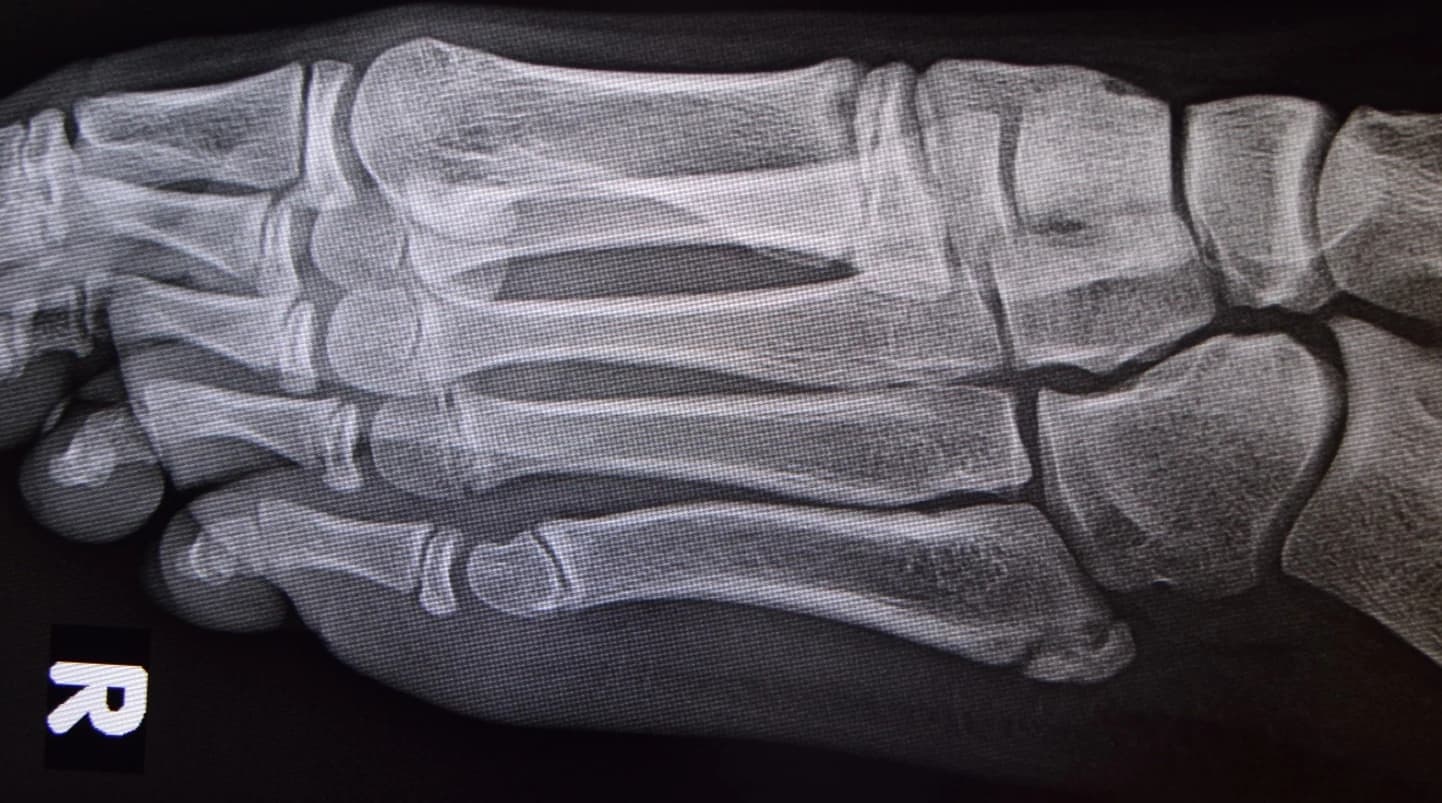
Pain on the outer edge of the foot in a sporty child can be Iselin's disease, a growth plate problem. It's uncommon but harmless, and it settles with rest, care and time.
If your sporty child complains of pain on the outer edge of their foot, about halfway along, one possible cause is Iselin's disease. It's an irritation of a growth plate, and while it's much less common than heel pain in children, it's worth knowing about because it's easily mistaken for a fracture.² It settles once your child stops growing.¹,³
What is Iselin's disease?
The long bone on the outside of the foot is the fifth metatarsal. At its base, near the middle of the outer foot, there's a bony bump. In growing children, this bump has its own growth plate (an apophysis) made partly of cartilage.³
A tendon from one of the muscles on the outside of the lower leg (peroneus brevis) attaches to this bump. When that tendon pulls on the growth plate over and over, the area can become irritated and painful. This is called a traction apophysitis.¹,³ It's the same kind of problem as Sever's disease in the heel or Osgood-Schlatter disease in the knee.¹
It mostly affects children aged about 10–15, around the time this growth plate appears and before it fuses.³
What causes it?
Iselin's disease is an overuse problem. It's seen mostly in children who play sport, especially sports with a lot of running and jumping.²,³ Repeated small stresses on the growth plate cause it, rather than a single injury.¹ Like other growth plate problems, it's more likely in children who are growing and have tight muscles and tendons.¹
Signs and symptoms
Your child may have:
- pain on the outer edge of the foot, over the bony bump at the base of the fifth metatarsal¹,³
- swelling over that bump¹
- pain that gets worse with sport and better with rest³
- trouble wearing shoes comfortably.³
The pain may also be worse when your child turns the sole of their foot outwards against resistance, or points their toes.¹
How is it diagnosed?
Your podiatrist will ask about the pain and your child's activities, then examine the foot. An x-ray is often useful here, because the main thing to rule out is a fracture at the base of the fifth metatarsal. On an x-ray, a normal growth plate can even be mistaken for a fracture.²,³ In Iselin's disease the x-ray can be normal or show the growth plate looking a little wider or in pieces.¹ If severe pain doesn't settle, an MRI can check for a stress fracture.¹
What can help?
Most children get better with simple care:¹,²
- Relative rest. Cut back on the activities that hurt, while staying active with ones that don't.
- Ice after activity.
- Stretching the tight muscles around the foot and lower leg.
- Offloading the area, for example with padding or changes to footwear to take pressure off the bump.¹,³
- Short-term pain relief. Ask your pharmacist what's suitable for your child.¹
If the pain is severe, a stiff-soled shoe or a walking boot for a short time can help it settle.¹ A cast is occasionally needed if nothing else works.³ Surgery is rarely needed.¹
Your child can usually return to full sport once their foot is no longer painful. We'll guide them back gradually.
Will it go away?
Yes. Iselin's disease is self-limiting. It settles when your child stops growing and the growth plate fuses to the rest of the bone, usually within 2–4 years.¹,³ The pain can come and go during that time, so the goal is to keep your child comfortable and active until then.
When to see a podiatrist
Book an assessment if your child has pain on the outside of their foot that keeps coming back or stops them playing sport. Because a fracture in this area can look similar, see a doctor or podiatrist promptly if the pain started after a fall or a rolled ankle, or if your child can't put weight on the foot.¹,³
See a doctor straight away if your child has severe pain, pain at night, a fever or seems unwell.¹
If your child has a sore foot, book an appointment with our podiatrists in Booragoon.
References
- Achar S, Yamanaka J. (2019). Apophysitis and osteochondrosis: common causes of pain in growing bones. American Family Physician, 99(10), 610–618. https://www.aafp.org/pubs/afp/issues/2019/0515/p610.html
- Forrester RA, Eyre-Brook AI, Mannan K. (2017). Iselin's disease: a systematic review. Journal of Foot and Ankle Surgery, 56(5), 1065–1069. https://doi.org/10.1053/j.jfas.2017.04.030
- Deniz G, Kose O, Guneri B, Duygun F. (2014). Traction apophysitis of the fifth metatarsal base in a child: Iselin's disease. BMJ Case Reports, bcr2014204687. https://doi.org/10.1136/bcr-2014-204687
Reviewed by Andrew Schox, Podiatrist, BSc(Hons) PGradDipPod MPod. Last reviewed October 2026.
Need Professional Podiatry Care?
Our experienced team is here to help with all your foot and ankle concerns. Book an appointment today for expert diagnosis and treatment.
Book an AppointmentRelated Articles

Cortisone injections: relief for foot and ankle pain
A cortisone injection can calm a painful joint, bursa or nerve within days, and the relief often lasts weeks to months. It works best as one part of a wider treatment plan.
Why are my toenails unsightly?
Thick, discoloured or misshapen toenails are common. Fungal infection, injury, ageing, skin conditions and ingrown nails are the usual causes, and most can be treated or managed.
Why do I get calf muscle cramps?
Calf cramps are common and usually harmless, often linked to tired muscles, exercise or age. Cramping pain that comes on with walking and eases with rest is different and needs checking.