
Köhler's disease
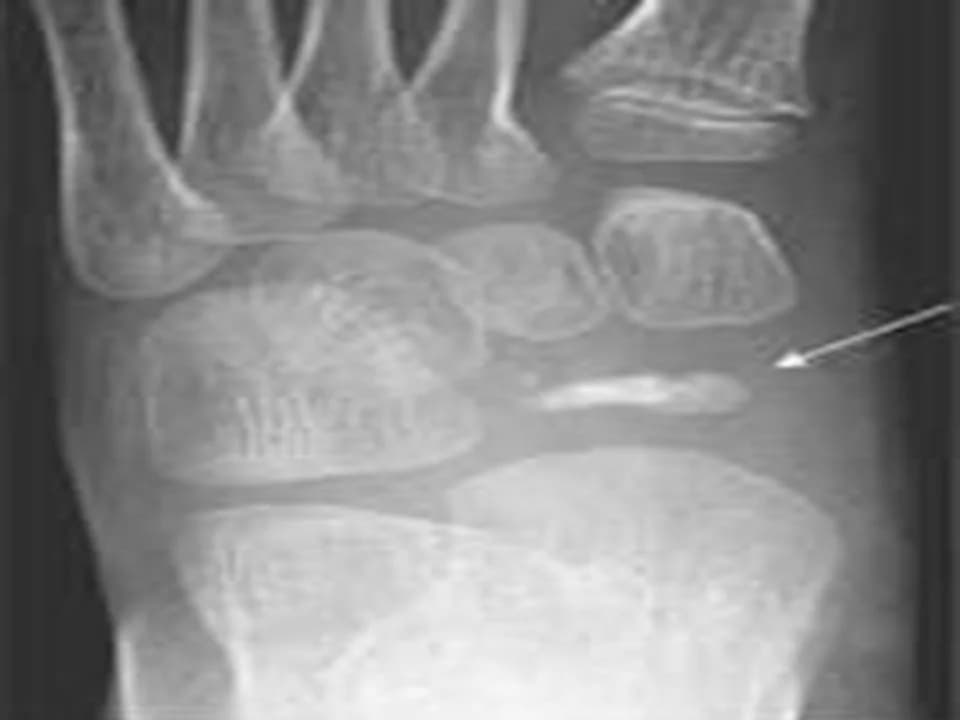
Köhler's disease is a rare cause of midfoot pain and limping in young children. It gets better on its own, and children almost always grow up with a normal foot.
Köhler's disease is an uncommon condition that causes pain in the middle of the foot in young children, usually boys aged 4–7. If your child has been diagnosed with it, the most important thing to know is that it gets better on its own, and children almost always end up with a normal foot as adults.¹,² Treatment is about easing the pain while the bone heals.
What is Köhler's disease?
Köhler's disease affects the navicular, a bone on the inner side of the foot near the top of the arch. For a while, the bone's blood supply is interrupted, so part of the bone breaks down. The body then repairs it and the bone rebuilds itself.¹
It usually affects children of preschool age, typically between 4 and 7 years, and it's rare in older children.¹ Boys get it about 4–5 times more often than girls.¹ Most children have it in one foot, but about 1 in 5 have it in both.¹
What causes it?
The exact cause isn't known. The navicular is one of the last bones in the foot to harden from cartilage into bone, at around 18–24 months in girls and 30–36 months in boys. Because it develops late, it may be more easily squeezed by the bones around it and by the everyday load of walking and running. This may briefly cut off its blood supply.¹ Some differences in the shape of the foot may also put extra stress on the bone.¹
Köhler's disease isn't caused by anything you or your child did, and it isn't an infection.
Signs and symptoms
Your child may have:¹
- pain in the middle of the foot, on the inner side, that is worse with walking, running and jumping and eases with rest
- tenderness when you press on the bone
- mild swelling over the area
- a limp.
Sometimes Köhler's disease is found by chance on an x-ray, when a child has no pain at all.¹
The condition is diagnosed with an x-ray, which shows the navicular looking flatter and denser than normal.¹ The bone can take 1–2 years to look normal on x-ray again, even after the pain has gone.¹ That doesn't mean your child is still unwell.
What can help?
Because Köhler's disease heals on its own, treatment aims to ease pain and protect the foot while it recovers. Surgery is very rarely needed.¹
Rest and pain relief. Cutting back on running and jumping, using an ice pack wrapped in a cloth, and pain relief can help.¹ Ask your GP or pharmacist which pain relief is right for your child.
Footwear and arch support. Supportive shoes, and sometimes soft arch supports or orthoses (shoe inserts), can make walking more comfortable.
A cast or moon boot. If the pain is more severe, immobilising the foot in a short leg cast for about 3–6 weeks may be recommended.¹ A removable walking boot (moon boot) is sometimes used instead. A cast doesn't change the long-term outcome, but it can shorten how long your child has pain.²
When to see a podiatrist
See a podiatrist or GP if your child:
- has foot pain that lasts more than a few days
- is limping or avoiding putting weight on one foot
- has a red, hot or very swollen foot, or a fever, which needs prompt medical attention.
Pain in the middle of the foot in a child can have several causes, so it's worth getting it checked properly. If foot pain carries on after Köhler's disease has healed, other causes should be looked for.²
At Foot Ankle Lower Limb, we can assess your child's foot, arrange an x-ray if needed, and help keep them comfortable and active while the bone heals. To arrange a check-up, book an appointment.
References
- Mazzotti A, Gemini G, Langone L, et al. (2025). Foot osteochondroses. Children, 12(9), 1114. https://doi.org/10.3390/children12091114
- Borges JL, Guille JT, Bowen JR (1995). Köhler's bone disease of the tarsal navicular. Journal of Pediatric Orthopaedics, 15(5), 596–598. https://doi.org/10.1097/01241398-199509000-00009
Reviewed by Andrew Schox, Podiatrist, BSc(Hons) PGradDipPod MPod. Last reviewed October 2026.
Need Professional Podiatry Care?
Our experienced team is here to help with all your foot and ankle concerns. Book an appointment today for expert diagnosis and treatment.
Book an AppointmentRelated Articles

Cortisone injections: relief for foot and ankle pain
A cortisone injection can calm a painful joint, bursa or nerve within days, and the relief often lasts weeks to months. It works best as one part of a wider treatment plan.
Why are my toenails unsightly?
Thick, discoloured or misshapen toenails are common. Fungal infection, injury, ageing, skin conditions and ingrown nails are the usual causes, and most can be treated or managed.
Why do I get calf muscle cramps?
Calf cramps are common and usually harmless, often linked to tired muscles, exercise or age. Cramping pain that comes on with walking and eases with rest is different and needs checking.