
Morton's neuroma
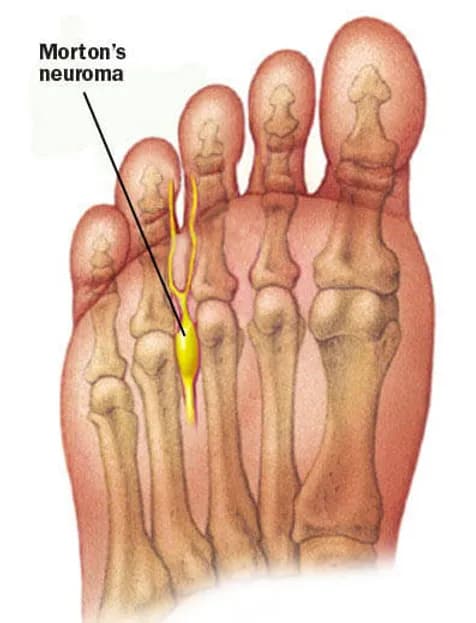
Morton's neuroma is an irritated, thickened nerve between the toes that causes burning or shooting pain in the ball of the foot. Wider shoes and padding are the first step.
Morton's neuroma is a common cause of pain in the ball of the foot. It often feels like a sharp or burning pain between your toes, or like you're walking on a pebble. Simple changes to your footwear are the place to start, and many people's symptoms ease with self-care.¹
What is Morton's neuroma?
Your toes are supplied by small nerves that run between the long bones of the foot (metatarsals). Morton's neuroma is a thickening of the tissue around one of these nerves after it has been irritated or damaged.¹ Despite the name, it isn't a tumour or cancer. It's a non-cancerous enlargement of the nerve.²
It most often affects the nerve between the 3rd and 4th toes, and less often the one between the 2nd and 3rd toes.²
What causes it?
The nerve becomes irritated or damaged as it's squeezed between the toe bones.¹ Morton's neuroma is often linked with:
- tight, pointy or high-heeled shoes
- a lot of running, or other activities that put pressure on the front of the foot
- other foot problems, such as flat feet, high arches, bunions or hammer toes.¹
Signs and symptoms
Common symptoms include:
- shooting, stabbing or burning pain between the toes, often the 3rd and 4th¹
- a feeling that there's a pebble or lump stuck under your foot¹
- pain that spreads into the toes²
- tingling or numbness in the foot.¹
Symptoms are often worse when you move your foot or wear tight or high-heeled shoes. Without treatment, it often gets worse over time.¹
What can help?
Self-care first. These steps help many people:¹
- Wear wide, comfortable shoes with a low heel and soft sole.
- Avoid tight, pointy shoes, high heels and thin-soled shoes.
- Use soft insoles or metatarsal pads (small pads that sit behind the ball of the foot).
- Rest and raise your foot when you can.
- Cut back on high-impact activities, such as running and jumping, while it settles.
- If you're overweight, losing some weight can help.
Ask your pharmacist or GP about pain relief medicine.
What a podiatrist can do. At Foot Ankle Lower Limb, we'll confirm the diagnosis and check for other causes of forefoot pain. We may arrange an ultrasound scan if needed. Treatment may include:
- footwear advice
- custom-made orthoses (shoe inserts) with padding to take pressure off the painful nerve¹
- hands-on mobilisation of the foot joints, which has some evidence for easing pain.³
Injections. If these steps don't help, a steroid injection is an option.¹ It's one of the better-studied treatments and can ease pain for some people.³ However, the results across studies are mixed.² Injections given with ultrasound guidance work better than those given without it.² Side effects are uncommon but can include thinning of the skin or of the fat pad under the foot.²
Surgery. If your symptoms are severe and other treatments haven't worked, a foot and ankle surgeon may recommend removing the affected part of the nerve.¹,² Surgery can have complications, such as a thickened scar,² so it's worth trying other treatments first. We can arrange a referral if you need one.
When to see a podiatrist
See a podiatrist or GP if:¹
- your foot pain is severe or stops you doing your normal activities
- the pain is getting worse or keeps coming back
- it hasn't improved after 2 weeks of self-care
- you have tingling, weakness or numbness in your foot
- the pain started after a recent foot injury or surgery.
If you have diabetes, poor circulation or a weakened immune system, get any new foot pain or numbness checked promptly.
If you think you might have a Morton's neuroma, book an appointment with our podiatrists.
References
- NHS (2025). Morton's neuroma. https://www.nhs.uk/conditions/mortons-neuroma/
- Matthews BG, Thomson CE, Harding MP, et al. (2024). Treatments for Morton's neuroma. Cochrane Database of Systematic Reviews, 2, CD014687. https://doi.org/10.1002/14651858.CD014687.pub2
- Matthews BG, Hurn SE, Harding MP, et al. (2019). The effectiveness of non-surgical interventions for common plantar digital compressive neuropathy (Morton's neuroma): a systematic review and meta-analysis. Journal of Foot and Ankle Research, 12, 12. https://doi.org/10.1186/s13047-019-0320-7
Reviewed by Andrew Schox, Podiatrist, BSc(Hons) PGradDipPod MPod. Last reviewed October 2026.
Need Professional Podiatry Care?
Our experienced team is here to help with all your foot and ankle concerns. Book an appointment today for expert diagnosis and treatment.
Book an AppointmentRelated Articles

Cortisone injections: relief for foot and ankle pain
A cortisone injection can calm a painful joint, bursa or nerve within days, and the relief often lasts weeks to months. It works best as one part of a wider treatment plan.
Why are my toenails unsightly?
Thick, discoloured or misshapen toenails are common. Fungal infection, injury, ageing, skin conditions and ingrown nails are the usual causes, and most can be treated or managed.

Why do I get calf muscle cramps?
Calf cramps are common and usually harmless, often linked to tired muscles, exercise or age. Cramping pain that comes on with walking and eases with rest is different and needs checking.